Bentsen—Rio Grande Valley State Park

The Texas Parks and Wildlife Department manages 95 state parks in the Lone Star State. My goal is to visit all of them. Regardless of where you live in Texas, you are within a short drive of a state park or a state natural area — places where you can go hiking, biking, camping, boating, birding, or whatever scratches your outdoor itch.

If you are a history buff then you are in luck. Several parks preserve and bring Texas history to life — everything from ancient pictographs, twentieth century battleships, hallowed burial grounds, silent battle sites, and Spanish missions. You can even visit the place where Texas declared its independence from Mexico. We are indeed fortunate to have so many parks in Texas.
Bentsen State Park SignBentsen—Rio Grande Valley State Park, located just outside of my hometown of Mission, is the first state park I visited as a kid. As a Boy Scout, I spent many days camping and hiking all over this 760-acre park. This is where I learned to identify a variety of birds, where to locate the constellations in the night sky, and how to leave a campsite better than I found it.
Bentsen Birding SignNamed after the family of the late Senator Lloyd Bentsen, this park serves as the headquarters of the nine World Birding Center sites in South Texas. More than 340 species of birds and more than 200 species of butterflies have been documented within the park’s boundaries. Because the park is a World Birding Center, no vehicular traffic is allowed in the park. Access into the park is restricted to walking, biking, or tram.
Bentsen Bird Viewing AreaBentsen is more than a popular stop for migratory birds and butterflies, it’s a very popular place for birders, locals, and winter Texans. The park offers several convenient places from which to watch birds, including a two-story high Hawk Observation Tower. A pair of binoculars is definitely a plus when visiting the park. And, if you are not a birder, pick up an inexpensive guide to the birds of the area at the park store and see how many species you can spot.
Bentsen State Park MesquiteLike all of our state parks, Bentsen is a Texas treasure. I enjoy riding my bike in the park and stopping at the designated bird observation areas to see the amazing varieties of birds. And because I happen to love mesquite trees, I enjoy taking photos of these trees with their gnarled trunks and branches throughout the park. The park is also home to other varieties of trees, including the beautiful ebony.
Bentsen State Park BikingI always enjoy visiting Bentsen—Rio Grande Valley State Park whenever I am in South Texas. It is a nostalgic and peaceful place for me. I am glad that in 1944 the Bentsen family gave this land to the state of Texas with the understanding that it be maintained and preserved for the enjoyment of future generations. Their generous gift continues to be enjoyed by countless visitors from all over the world.

Enchanted Rock Defaced

The Lone Star State is home to some of the most beautiful natural areas in the country. Along with our state parks, these natural areas are managed by the Texas Parks and Wildlife Department for the enjoyment of all Texans and guests to the Lone Star State. The rules and regulations about what visitors can and should not do are designed to ensure that we steward these natural treasures for our own enjoyment and that of future generations.

The Texas State Parks Rules and Regulations clearly state what should be a no-brainer in regard to what one should not do to geological features: “It is an offense for any person to take, remove, destroy, deface, tamper with, or disturb any rock, earth, soil, gem, mineral, fossil, or other geological deposit except by permit issued by the director.” The problem is that some people who visit our parks and natural areas have no brains.

Earlier this week, two individuals of questionable intelligence visited Enchanted Rock State Natural Area. Most people who visit our parks carry water bottles, snacks, and trekking poles. These dull-witted guests carried spray paint — which puts their actions into the premeditated category. Honestly, who carries a can of spray paint with them to a state park? That’s like taking an accordion with you when you go deer hunting.
Enchanted Rock TaggedThe parks service believes that two individuals seen in a photograph are responsible for tagging one of the granite formations at Enchanted Rock. The offense took place sometime between 3:00 PM and 5:00 PM on Sunday, March 20. Further evidence that these culprits have a combined IQ lower than that of a bucket of rocks is the cryptic message they graffitied onto the face of the geological formation: CA$H TRUCK. Really?

And now, the search is on to find the two imbeciles who messed with Texas. The Parks and Wildlife folks are utilizing social media to circulate the pic of the alleged suspects. Hopefully someone will recognize them and contact the TPWD at 830-685-3636 or email Doug Cochran at doug.Cochran@tpwd.texas.gov. In the meantime, dollars that could have been used for something better must now be invested in cleaning up after Goofus and Doofus.

So, what should you do if you see someone defacing property at one of our state parks or natural areas? At the very least use your smart phone to take pics of the violators. If you do not feel it is safe to confront them, then follow them to their vehicle and take a photo of their license plate. And, report it to park personnel as quickly as possible.

Most of our state parks and natural areas are big and vast, making it hard for park personnel to know everything that is going on. These guardians of our parks need our eyes and our cooperation. Every Texan has a responsibility to help steward the precious natural areas that we are all privileged to enjoy. So, keep your eyes open for Goofus and Doofus. Let’s stop them before they strike again!

Marco’s Burgers and Fries

Every road trip is an opportunity for me to continue my search for the best burgers in the Lone Star State. That means I stop and eat at a lot of burger joints. And just about the time I think that I can’t possibly find a better burger, it happens. I find a better burger!
IMG_8398On a recent road trip to the Rio Grande Valley, I visited Marco’s Burgers and Fries in my hometown of Mission. This turned out to be one of the best decisions I have made on my burger quest. Lots of places serve varieties of burgers distinguished by creative combinations of this or that added to a burger. Marco’s Burgers, however, takes the burger experience beyond the ordinary.
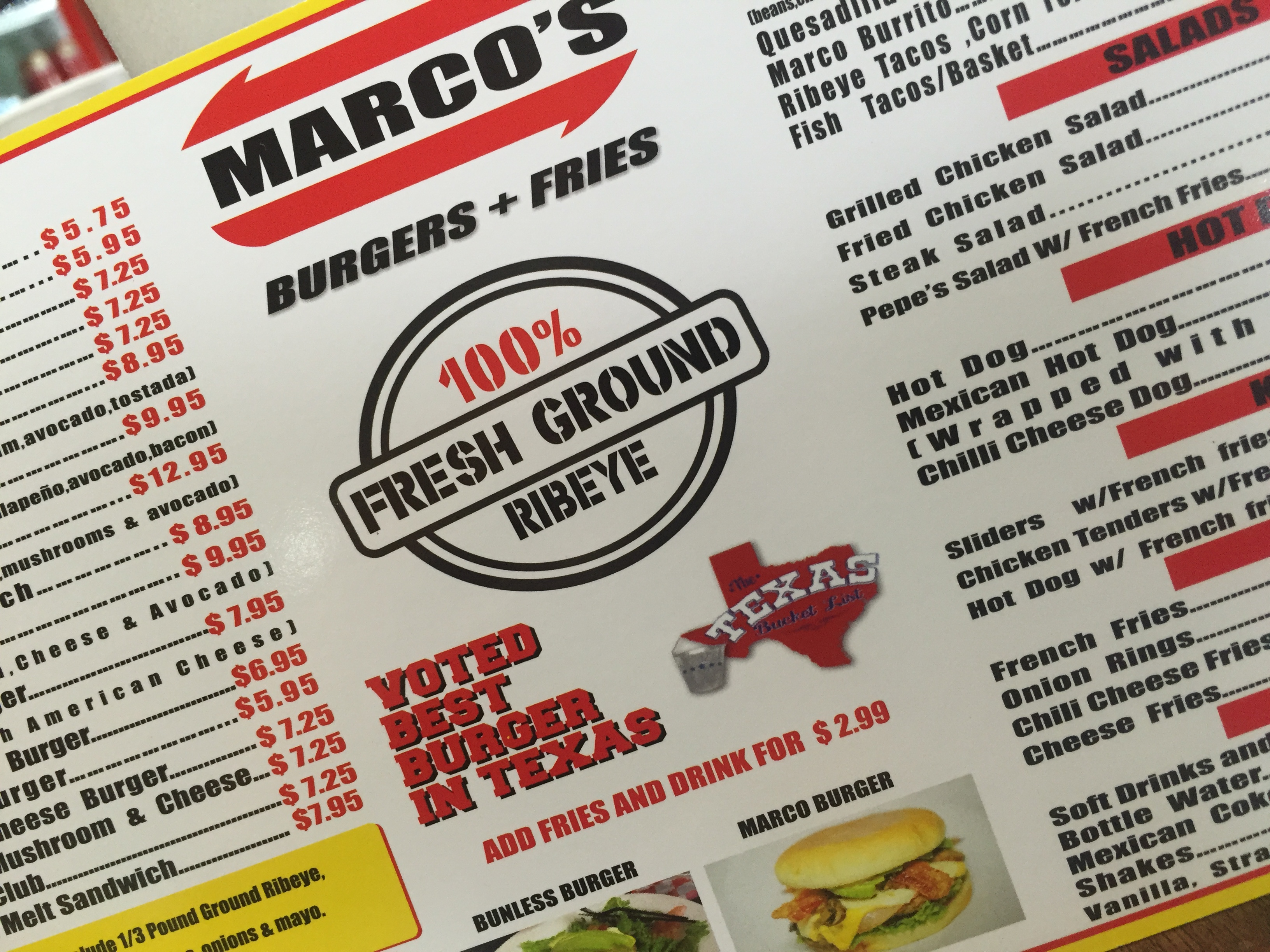
Marco's Burgers FlyerMarco Suarez, the owner of Marco’s Burgers, has done more than just add stuff to the basic buns and meat that make up a burger. Marco went to the heart of the matter — the meat! He figured that if you want to make a better burger you have to get the meat right. So, Marco decided to take ribeye and grind it daily. He offers his customers mouth-watering burger patties made of 100% fresh ground ribeye with nothing added to the meat.
Marco's MenuWhen I arrived at Marco’s Burgers located at 2507 East Griffin Parkway between Mission and McAllen, the first thing I noticed was how clean the place was. The young lady behind the counter offered a welcoming greeting and took the time to explain the various options on the menu. I am partial to bacon cheeseburgers so that is what I ordered, along with a side of onion rings and sweet tea.
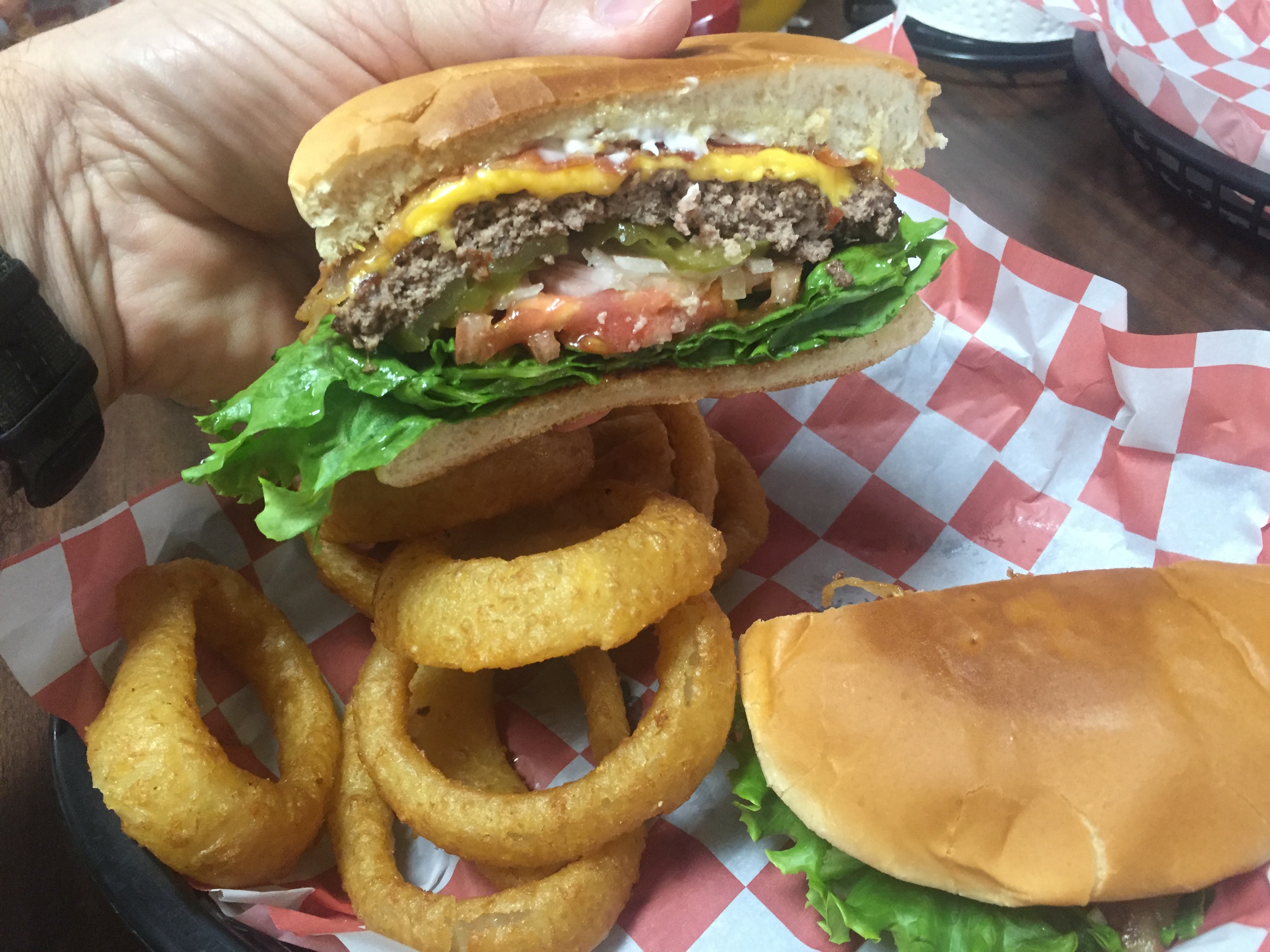
Marco's Burger in HandMy first bite confirmed what I had hoped — that this was going to be one delicious burger. And, indeed it was. Adding bacon and cheese or anything else to a burger is ok. But the ground ribeye meat made everything about this burger stand out. The meat was lean, moist, full of flavor, and cooked to perfection. This burger puts to shame any burger made with a hockey puck patty pulled out of the freezer and tossed on a grill.
Marco's Sweet Potato FriesIn addition to onion rings, I sampled the sweet potato fries and regular cut fries. Both were delicious but I believe that I will order sweet potato fries on my next visit. These were really tasty. And, I have already made up my mind to go beyond my normal bacon cheeseburger on my next visit. Marco’s offers several tempting combinations of their ground ribeye burgers.
Marco's Burger CounterI visited another highly-rated burger joint in the Valley on this road trip. But, I have to say that I found that experience somewhat disappointing and have placed that burger on my list of places I will not blog about. Thankfully, Marco’s Burgers and Fries redeemed this road trip in regard to my search for a memorable burger experience. It’s no wonder that Marco’s Burgers was awarded Best Burgers in Texas on the Fall 2013 season of The Texas Bucket List.
Marco's Burgers ExteriorIf you happen to live in South Texas or just wander in that direction, I hope you will take the time to visit Marco’s Burgers and Fries. I am confident that you will come away more than satisfied by this burger that gets it right in every category. Thank you Marco and staff for a delicious and memorable dining experience. I hope to return again the next time I am in the neighborhood.

Iwo Jima Monument in Harlingen

On February 23, 1945, Associated Press photographer Joe Rosenthal captured a unique moment in time at the Battle of Iwo Jima. Rosenthal’s photograph of the Marines of Company E, 2nd Battalion raising the American flag atop Mount Suribachi endures as one of the greatest war photographs in U.S. history. His image resonated with the American people and became an iconic representation of the fierce resolve of the greatest generation to fight for the preservation of our democratic way of life.
Joe Rosenthal Iwo Jima PicRosenthal’s photograph stirred the heart of a sculptor named Dr. Felix W. de Weldon. On duty with the U.S. Navy at the time Rosenthal’s photograph was released, Dr. de Weldon immediately constructed a small scale model of the scene. After the war, he worked for nine and a half years to depict the scene on a more massive scale. Once Dr. de Weldon completed the plaster model, he spent an additional three years overseeing the bronze casting process.

After the massive sculpture was completed, the various parts were shipped to our nation’s capital and assembled at Arlington National Cemetery. President Dwight D. Eisenhower officially dedicated Dr. de Weldon’s bronze memorial on November 10, 1954 — the 179th anniversary of the U.S. Marine Corp.
Felix W de WeldonThe working model of the memorial was stored at Dr. de Weldon’s summer home and studio in Newport, Rhode island. In October 1981, Dr. de Weldon gave this full-sized working model to Marine Military Academy in Harlingen, Texas. Dr. de Weldon felt that the climate at this South Texas location was ideal for the preservation of the molding-plaster figures.

The fact that Corporal Harlon H. Block, the Marine placing the flagpole into the ground, was a native of the nearby town of Weslaco also influenced Dr. de Weldon’s decision about where his sculpture should permanently reside. Block was killed at Iwo Jima just six days after the flag raising. His gravesite is located behind the monument.
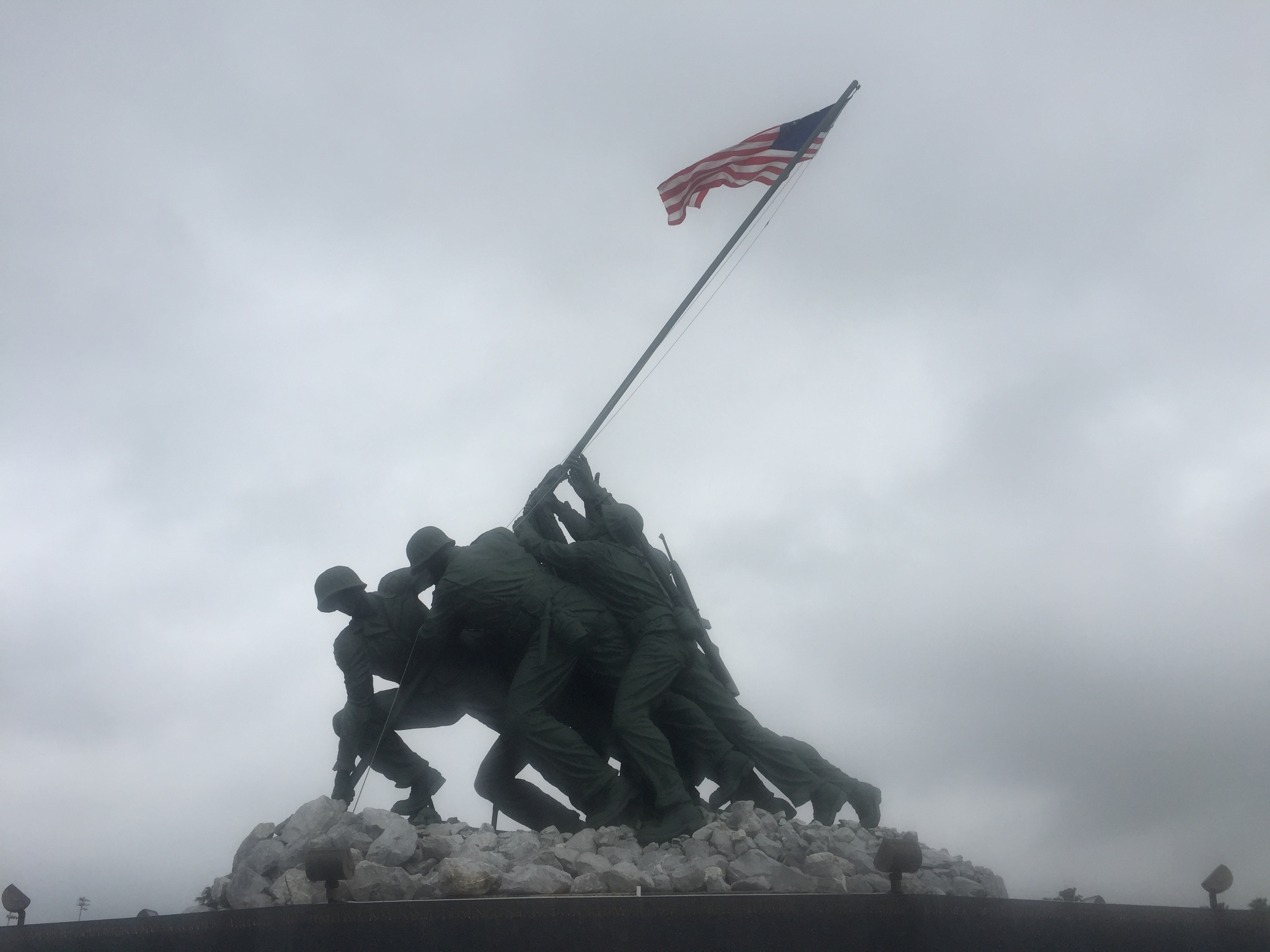
Iwo Jima Monument MMAThe massive sculpture, dedicated April 16, 1982, is situated on the Marine Military Academy Parade Ground. When my wife and I drove to Harlingen to visit the Iwo Jima Monument and turned onto Iwo Jima Boulevard, our first sight of the monument caught us completely off guard. Our jaws dropped at the inspiring sight of this moment in time captured by a war photographer and sculpted by a Navy veteran.
Uncommon ValorDr. de Weldon hoped that his gift would serve as an inspiration to the young cadets at Harlingen’s Marine Military Academy. There is no doubt that it has done just that. But his gift also serves as an inspiration to the many visitors who travel to Harlingen from all over the country to see this magnificent memorial to a time when uncommon valor was a common virtue.
Iwo Jima Monument at MMAIf your travels take you anywhere near South Texas, make it a point to drive whatever extra miles you need to in order to visit the Iwo Jima Memorial and Museum at Marine Military Academy in Harlingen. Those of us who enjoy the blessings of living in the United States of America certainly owe a debt of gratitude to the men and women of the greatest generation for their courage and sacrifices. I am thankful for Joe Rosenthal and Dr. Felix W. de Weldon for their gift to the American people.

Discover Pan Dulce

Pan Dulce is the bread of my youth. This Mexican sweet bread was always available in our home when I was growing up. Today, a trip to my childhood home in South Texas means a visit to the panaderia (the Spanish word for bakery) to buy pan dulce. Just looking at the trays of pan dulce in the panaderia can stir up the most wonderful childhood memories.
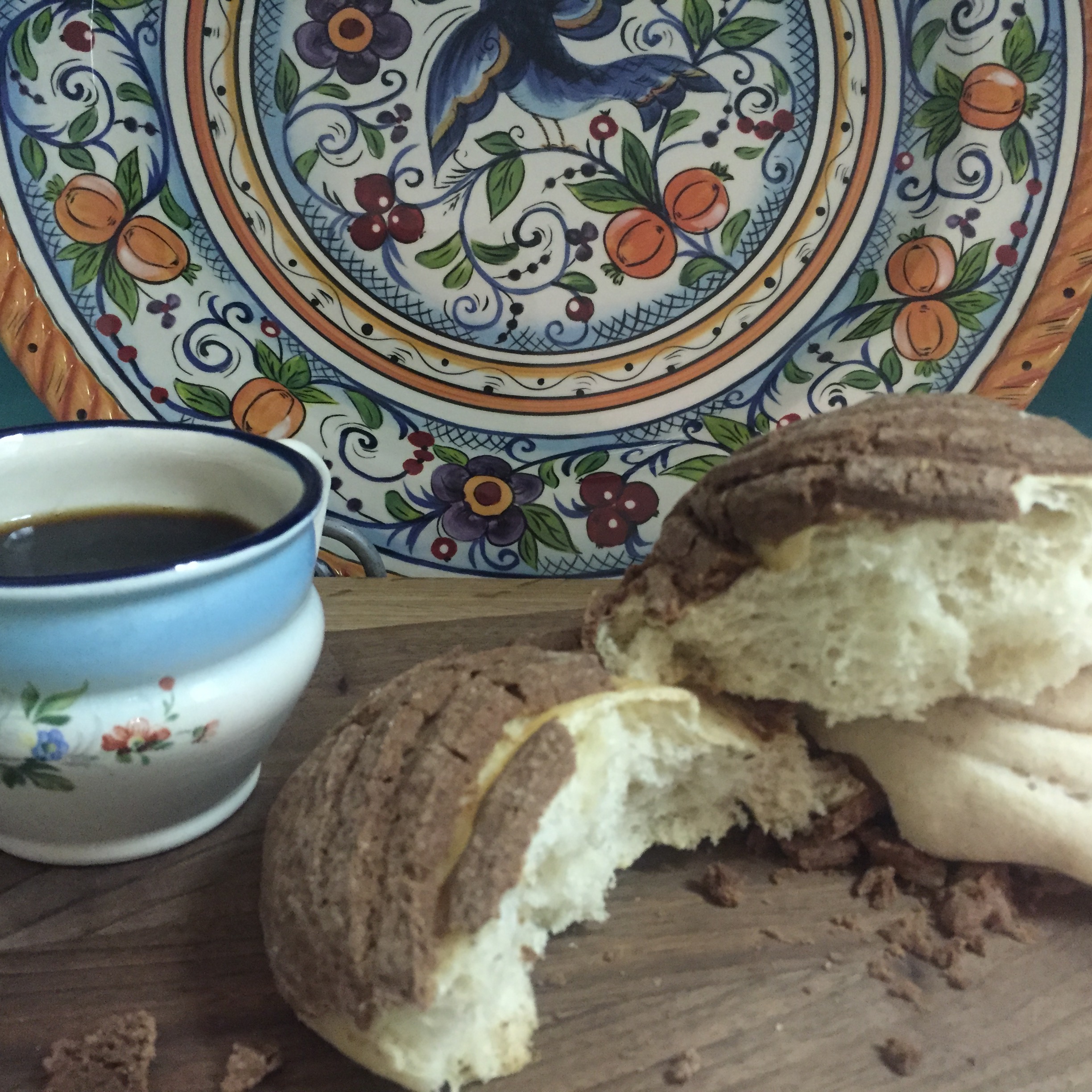
Pan DulceThe history of pan dulce dates back to the 16th century when the Spanish introduced wheat in Mexico. Initially, the indigenous people did not care for the bland taste of wheat. In fact, the first panaderias in Mexico were not popular at all. However, all of that changed when panaderos (bakers) adopted many of the baking techniques they learned from the French.

Soon, the panaderos added new ingredients such as corn flour, chocolate, vanilla, native fruits and vegetables, and raw sugar cane to their culinary creations — giving their breads distinctive flavors. The panaderos also created breads with playful designs and gave them names associated with their appearance.

Today, pan dulce is a tradition that is deeply ingrained in Hispanic culture. Pan dulce is enjoyed in the morning over a cup of hot coffee or cocoa or as a merienda (mid-afternoon snack). These sweet breads are enjoyed on ordinary days and holidays by people around the world. That’s because panaderias have made their way from Mexico to countries all over the planet.

When it comes to pan dulce, I have my favorites but confess that I have never been disappointed with anything I have sampled at a panaderia. If you have never visited a panaderia, I encourage you to do so. Discover pan dulce. Live adventurously. Spend a few bucks. Sample a lot. I promise that you will not be disappointed.
The photos below are of a few of my favorite Mexican sweet breads.

Conchas from the Spanish word for seashells.

Conchas, the Spanish word for seashells.


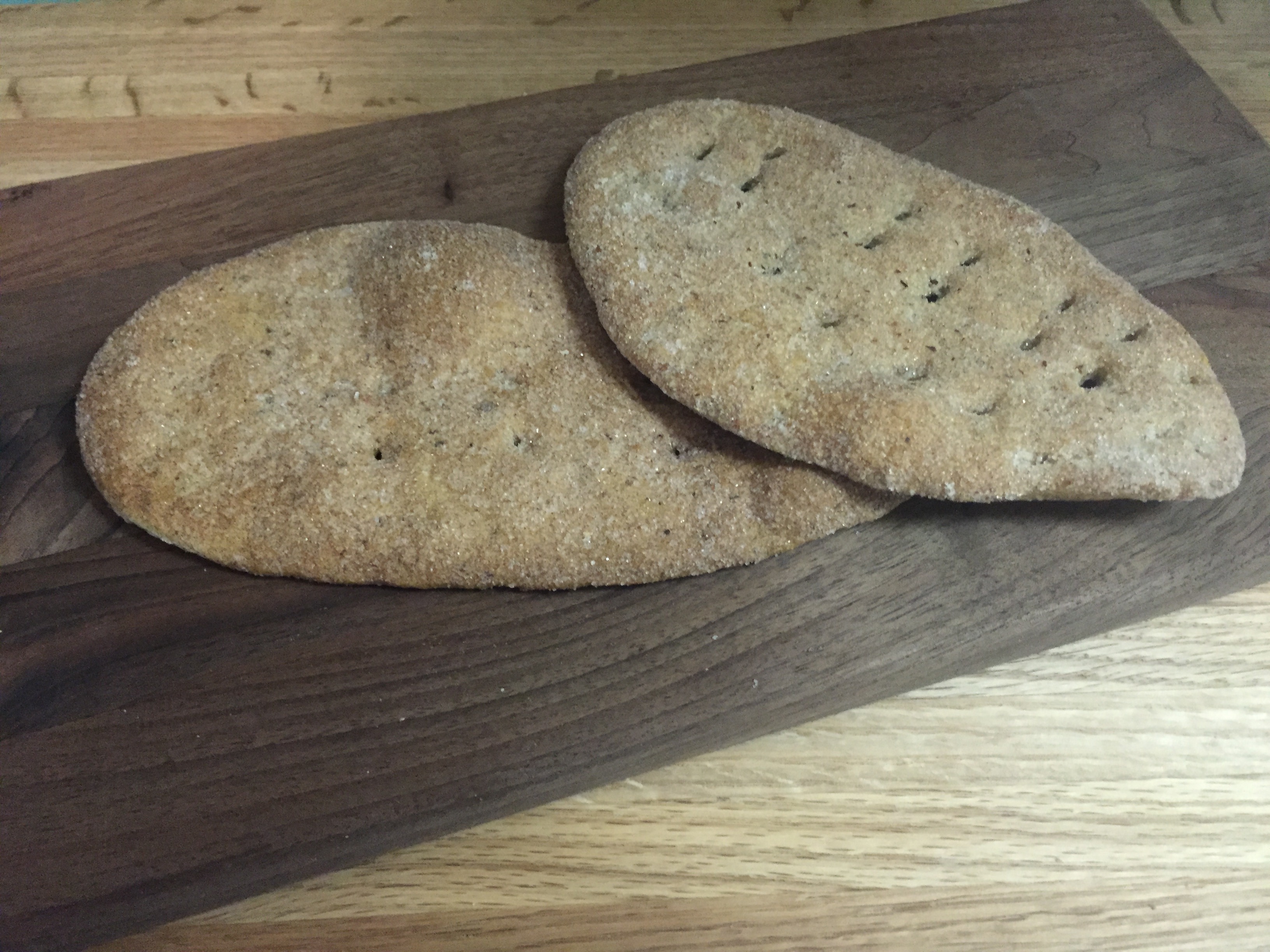
Huaraches from the Spanish word for sandals.

Huaraches, the Spanish word for sandals.


Marranitos, the Spanish word for piglets.

Marranitos, the Spanish word for piglets.


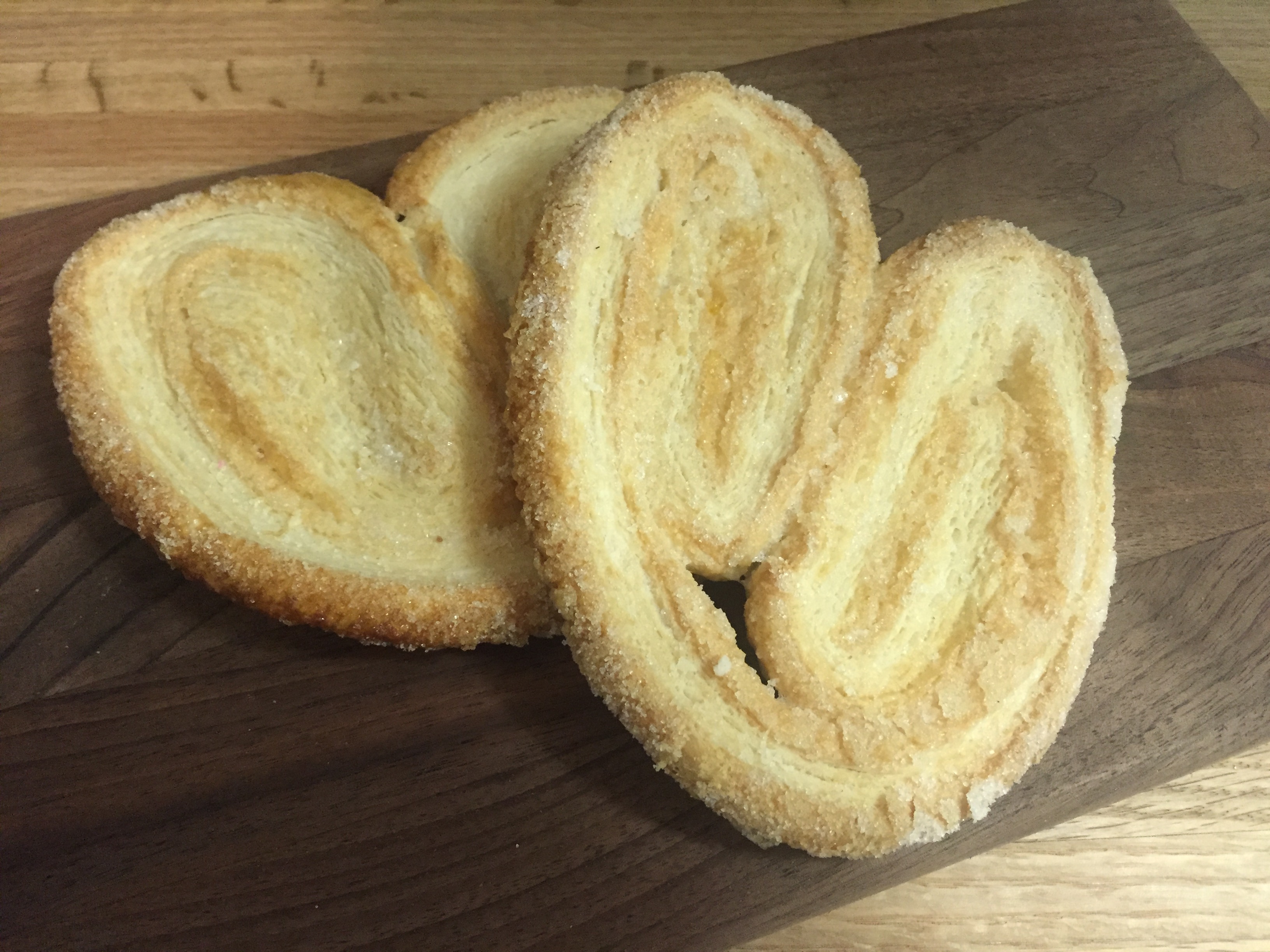
Orejas, the Spanish word for ears. Also called Elephant Ears.

Orejas, the Spanish word for ears. This pan dulce is also called Elephant Ears.


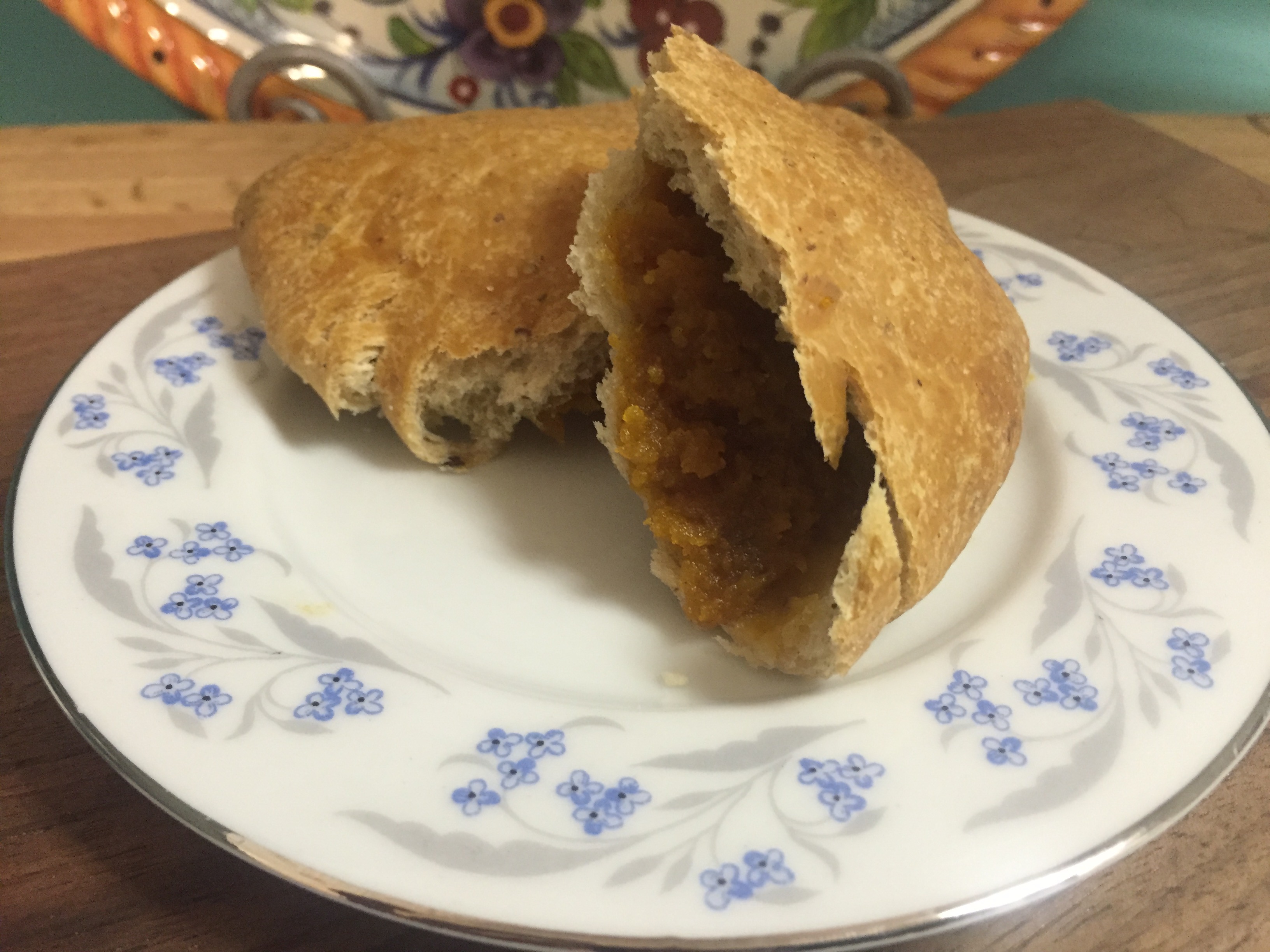
Empanada, the Spanish version of a fruit-filled turnover.

Empanada, the Spanish version of a fruit-filled turnover.

The Tortilla Burger

I think it is safe to say that there are not many eateries in the Lone Star State that make a tortilla burger. I first learned about this burger without buns on a recent episode of The Texas Bucket List. This “everything you should do, see, and experience in Texas” television show is one of my favorites. When I watched the feature on the tortilla burger I immediately added this culinary adventure to my personal Texas bucket list.
The Frosty DinerThe tortilla burger featured on The Texas Bucket List is served at The Frosty, a 50’s-themed diner located in Woodsboro. The small town of Woodsboro is located at the intersection of U.S. Highway 77 and Farm Road 2441 in Refugio County. Originally named Church, the name of the town was changed to Woodsboro sometime around 1907 after a fellow named Captain Tobias D. Wood, a real estate developer, sold a large ranch property.

The Frosty is located at 809 Wood Avenue, the same spot it has occupied for years. Over time, previous owners expanded the place to include a small dining area and a drive-thru window. You can also place your order at the convenient walk-up window. This cool little diner is very likely the birthplace of the tortilla burger, a creative solution born on a day when the kitchen ran out of hamburger buns. The rest is history.
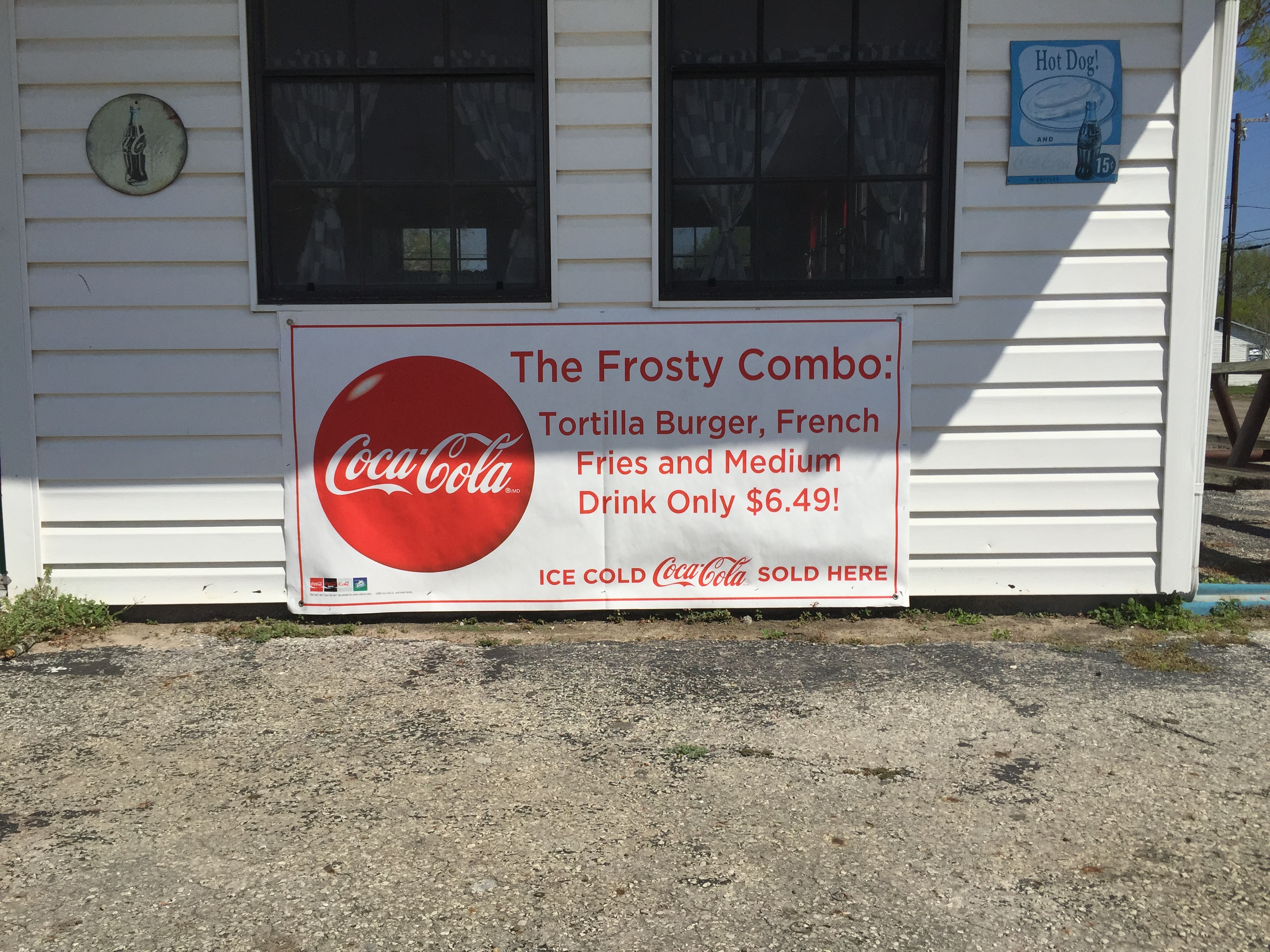
The Frosty ComboAfter weeks of waiting, my wife and I decided to swing by Woodsboro on our way from Katy to Corpus Christi. The first thing we noticed when we pulled in to the parking lot at The Frosty was the sign outside the building advertising The Frosty Combo — a tortilla burger, fries, and a medium drink for less than seven bucks. This is exactly why we were in Woodsboro.
The Frosty InsideOnce inside we were more than pleasantly surprised. To say that The Frosty is a clean diner would be an understatement. The place was immaculate. And the bathrooms, by the way, were every bit as clean as Buc-ee’s! But, I digress. Back to the reason we took this detour on our Spring Break road-trip — to eat a tortilla burger. We both ordered The Frosty Combo.
The Frosty Daniel LinaresDaniel Linares, the current and ninth owner of The Frosty, was in front of the stove. Since taking ownership, he has expanded the menu but keeps alive the tortilla burger tradition. I told Daniel that we had come all the way from Katy to try the tortilla burger for ourselves. He promised us a good dining experience — and he delivered on his promise.
The Frosty Tortilla BurgerThe thought of eating a burger that replaces buns with tortillas sounds counterintuitive. I mean, who slathers mustard on a lightly fried corn tortilla? But, counter-intuitiveness aside, the tortilla burger has endured at The Frosty because it actually works. The tortillas do nothing to rob the burger of its integrity but, in fact, contribute their own distinct flavor to enhance the entire burger experience.
IMG_8237As for the first bite — surprisingly delicious. Who would have thought that a burger as crazy as this would be this good. The crispy, pepper-speckled fries were also tasty. Add a glass of tea with crunchy ice and this turned out to be a great meal. Cheryl and I are really glad that we stopped by The Frosty and hope to do so again.
The Frosty CarIf you find yourself anywhere near Woodsboro, live adventurously. You owe it yourself to stop by The Frosty to try their tortilla-clad burger. As for me, this hybrid burger has definitely earned a place on my personal list of delicious burgers in the Lone Star State. The tasty tortilla burger — only in Texas!

Road-Tripping Close to Home

One of the advantages to living anywhere in the Lone Star State is having quick access to off-the-beaten-path drives. The Lone Star State’s network of Farm to Market roads can connect travelers with some of the most scenic places in the state. I enjoy wandering down these backroads where I can soak in the richness of Texas.
Gravel RoadHere is a sample of one of my no-agenda backroads excursions. The starting point was my home in beautiful Katy just west of Houston. I have convenient access to Interstate 10 and from there to Farm to Market roads and even more remote unpaved roads that lead me deeper into the heart of Texas.
BluebonnetMy first stop was at the San Felipe de Austin State Historic Site. Founded in 1823 by Stephen F. Austin, the Father of Texas, this little colony was the focal point for issues related to the immigration and settlement of American colonists in Mexican-controlled Texas until 1836. Austin built his only home in Texas at San Felipe de Austin. His log cabin also served as the colony’s land office and became the center of San Felipe commerce.
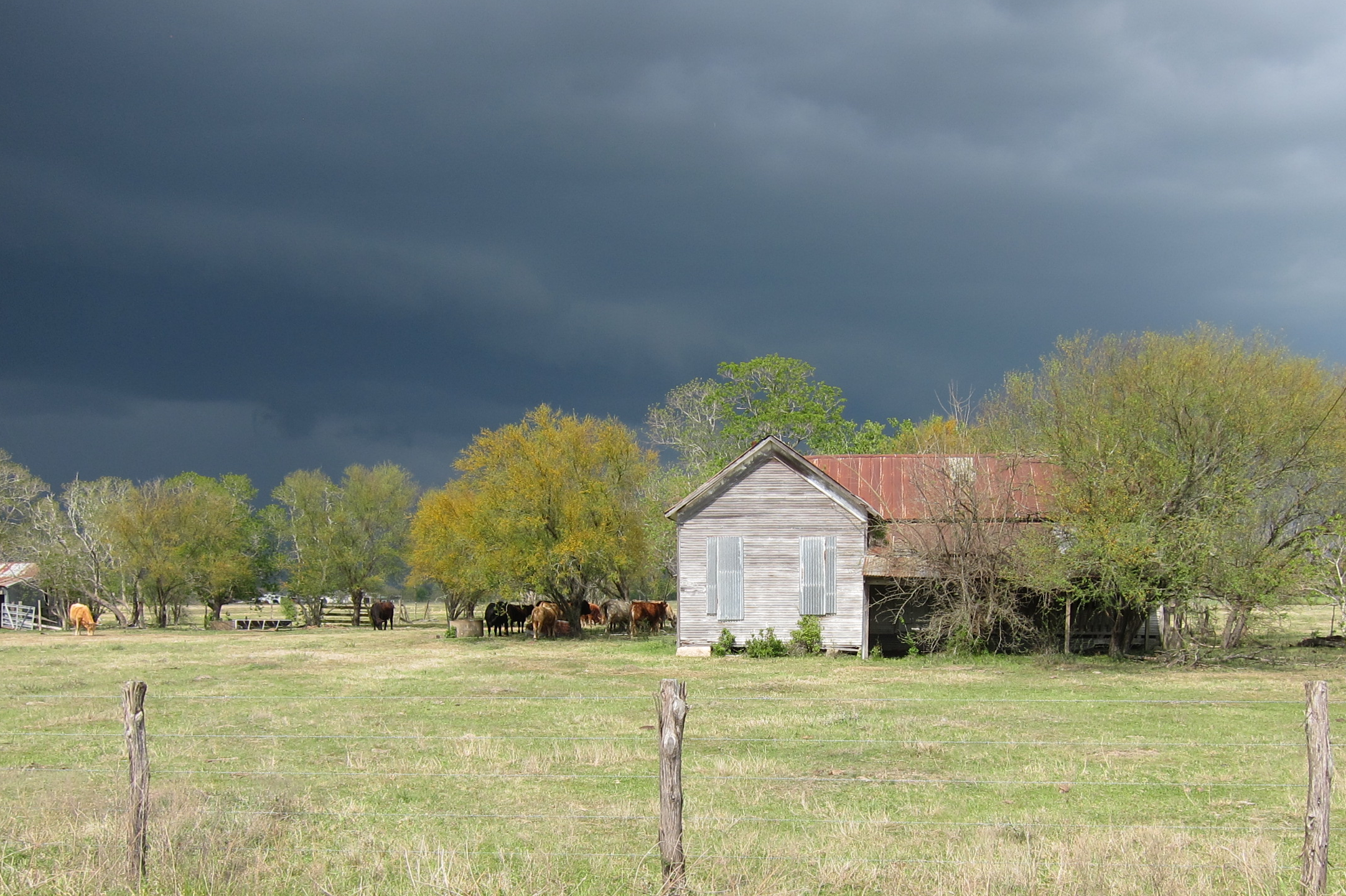
Austin's CabinFrom San Felipe I headed farther west on my backroads excursion. I enjoy the backroads because there is little traffic and I can drive slowly in order to better appreciate the sights. While driving, I received a Weather Channel message on my phone alerting me to severe thunderstorms in the area. I could see the approaching storm in the distance. The darkening skies created some beautiful light, making all of the sights a little more dramatic.
RR TracksI especially enjoyed seeing the old houses and farm buildings, places no longer inhabited that are slowly losing the battle against time and the elements. Looking at these old houses always makes me wonder about who might have lived there or who looked forward to returning there to visit family or friends on holidays and ordinary days. These old decaying homesteads always remind me that we are here for a season and should therefore make the most of every day that we have.
House and CowsAfter a couple of hours of driving, the thunderstorms finally arrived. There is nothing quite like the smell and sound of rain in the Springtime — absolutely therapeutic. My drive home was slower because of the heavy rains, but I absolutely enjoyed every mile. Although I only spent a few short hours away from home, I was refreshed by the experience.
Old House BarbedYou don’t have to travel far to have an adventure, but you do have to venture out and away from where you are. Little backroads excursions do not cost much and they do yield good returns. I encourage you to find your next adventure on a Farm to Market or gravel road close to your home. It’s a great way to redeem an afternoon and to learn a little more about the people and places that have shaped the history of your area.

5 Facts About Texas Bluebonnets

I love Springtime in Texas — that wonderful season when highways and byways in the Lone Star State are adorned with the most beautiful wildflowers. While you may not know the names of all of these colorful spring blooms, any self-respecting Texan can recognize the bluebonnet in the bunch.

The bluebonnet is “not only the state flower,” wrote historian Jack Maguire, “but also a kind of floral trademark almost as well known to outsiders as cowboy boots and the Stetson hat.” Maguire also said: “The bluebonnet is to Texas what the shamrock is to Ireland, the cherry blossom to Japan, the lily to France, the rose to England and the tulip to Holland.”

In anticipation of wildflower season in Texas, I thought it might be fun to consider five interesting facts about Texas bluebonnets.

1. The bluebonnet is the official state flower of Texas.

If you are from Texas, this is one fact that we all learned in elementary school. However, things could have been different when the Texas Legislature was considering our state’s official mascots in 1901. The bluebonnet was, in fact, one of three blooms under consideration by our elected officials at the time.
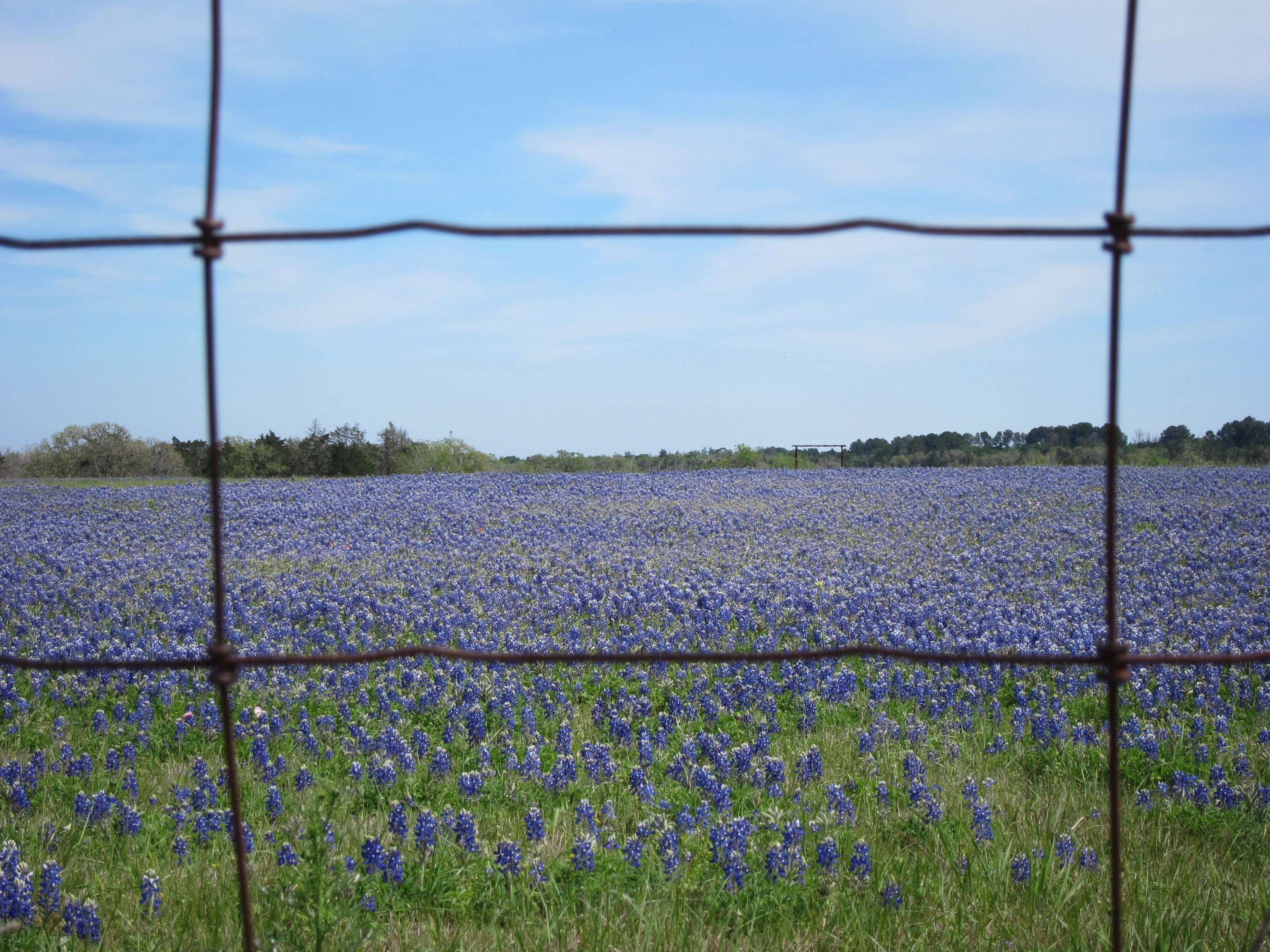
Bluebonnets Wire FenceThe cotton ball was nominated but did not garner much support because, quite frankly, it’s somewhat plain and not much to look at. A fellow named “Cactus Jack” Garner, reputed to be as prickly as his name, nominated the pretty flower of the prickly pear cactus. This hardy flower also lost out. These nominees paled by comparison to the bluebonnet, nominated by the National Society of Colonial Dames of America.

2. A bluebonnet by any other name.

The bluebonnet is also known by other names, including Buffalo Clover and Wolf Flower. The Spanish called the bluebonnet El Conejo from the Spanish word for rabbit because the bluebonnet’s white tip looks like a cottontail rabbit’s tail. The bluebonnet was also called Azulejo from azul, the Spanish word for blue. According to the Lady Bird Johnson Wildflower Center, this word can be loosely translated as “indigo bunting.”
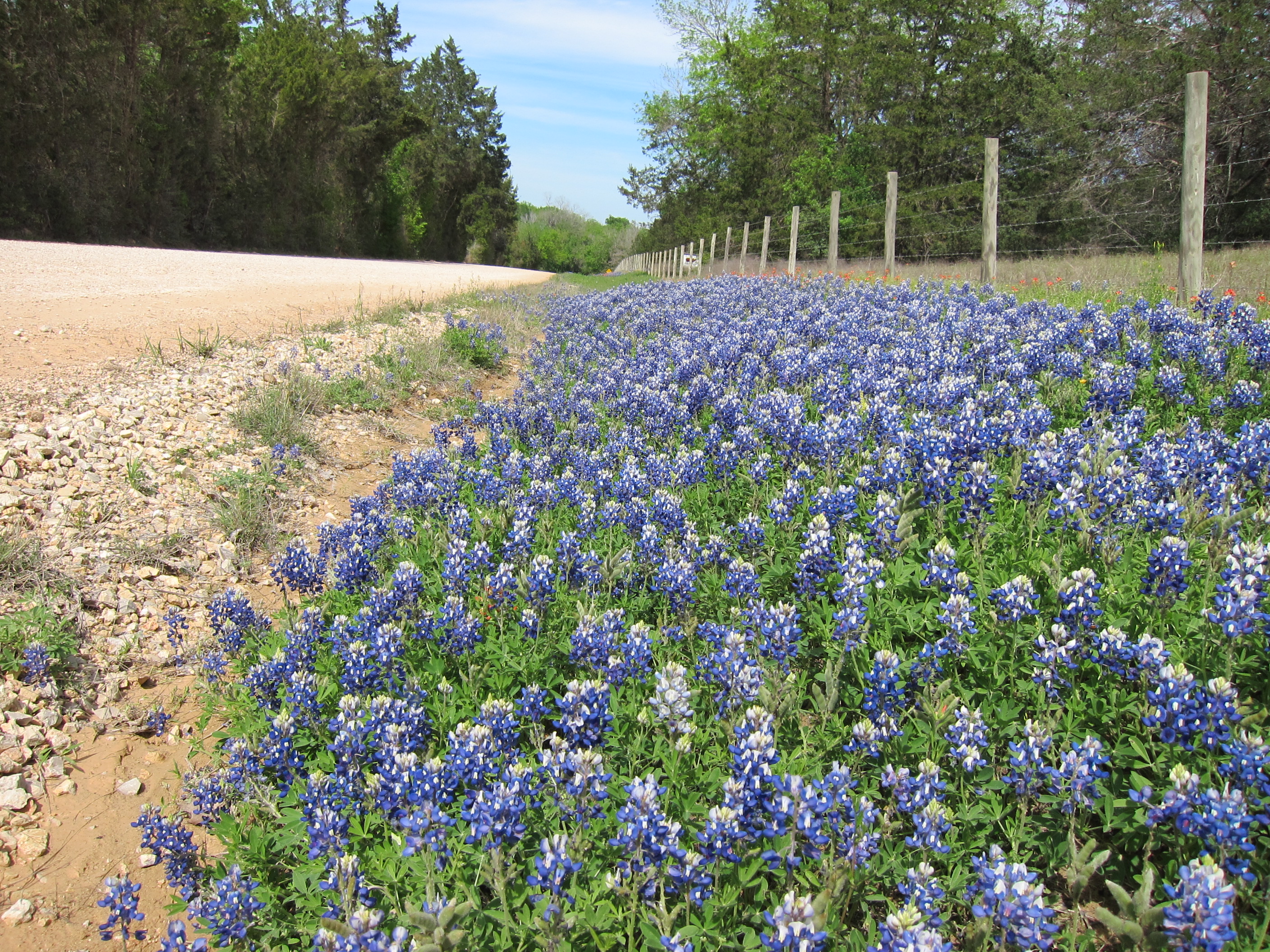
Bluebonnets Country RoadTexas is home to five native species of bluebonnets. In 1901, the Legislature selected lupinus subcarnosus as the state flower. However, citizens protested and petitioned that the lupinus texensis was a better choice because of its larger and more vibrant blooms. The matter was finally settled in 1971 when the Legislature classified all five species of bluebonnets as the Texas state flower.

3. Texas was the first state to plant flowers along state highways.

When the Texas Department of Transportation was organized in 1917, officials noticed that wildflowers were among the first plants to appear along roadways in the Springtime. In 1932, the department hired a fellow named Jac Gubbels as its first landscape architect. Gubbels was charged with maintaining, preserving, and encouraging the growth of wildflowers and other native plants along Texas roadways.
BG in BluebonnetsIn 1934, the department started to delay mowing along Texas roadways until the end of wildflower season. Today, the Texas Department of Transportation buys and sows about 30,000 pounds of wildflower seeds each year, making Texas highways among the most beautiful and scenic in the nation. Every year, flower lovers from around the state and around the nation can be found taking photos among the bluebonnets along Texas roadways.

4. And the award goes to…

The 1997 Texas Legislature named Ennis the official Bluebonnet City of Texas. And because Ennis is home to forty miles of roadsides covered with wildflowers, the Legislature also recognized Ennis as the Texas Bluebonnet Trail. Ennis holds its annual Ennis Bluebonnet Trails Festival every April.
Bluebonnets FenceThe town of Chappell Hill calls itself “the heart of Bluebonnet Country” and earned the title “Official State of Texas Bluebonnet Festival.” Chappell Hill holds its annual Bluebonnet Festival in April. And then there is Burnet, recognized by the Texas Legislature as the “Bluebonnet Capital of Texas.” Burnet holds its own Bluebonnet Festival during the second week of April.

5. Different species of bluebonnets bloom in the Spring.

Unless you are a naturalist, you will likely not be able to tell much difference among the various native species of bluebonnets. That’s ok! The important thing is to enjoy the bluebonnets that grow in or near your particular region. Here is a quick guide on where to go and what to look for.

Lupinus Texensis are found in Central Texas from late March to early April. Look for pointed leaflets and blue flowers tipped with white.

Lupinus Subcarnosus grow in Hidalgo, Leon, and LaSalle counties. Look for blunt leaflets and widely spaced flowers in late March.

Lupinus Havardii grow in Big bend country and grow up to three feet tall in early spring.

Lupinus Concinnus grow in the Trans-Pecos region in the early spring. These bluebonnets only grow as high as seven inches and produce flowers in purple, lavender and white.

And, finally, Lupinus Plattensis can be seen throughout the Panhandle plains from mid to late spring. These particular plants grow as tall as two feet.
Bluebonnets Road

Bobby J’s Old Fashion Hamburgers

My continuing quest to find delicious burgers in the Lone Star State recently led me to a place recommended by a reader who lives in San Antonio. He insisted that I had to eat at Bobby J’s Old Fashion Hamburgers — a popular burger joint in Helotes, a community located on the far northwest side of San Antonio. So, when my travels took me west, I did just that. A friend and I timed our trip so that we could stop for lunch at Bobby J’s.
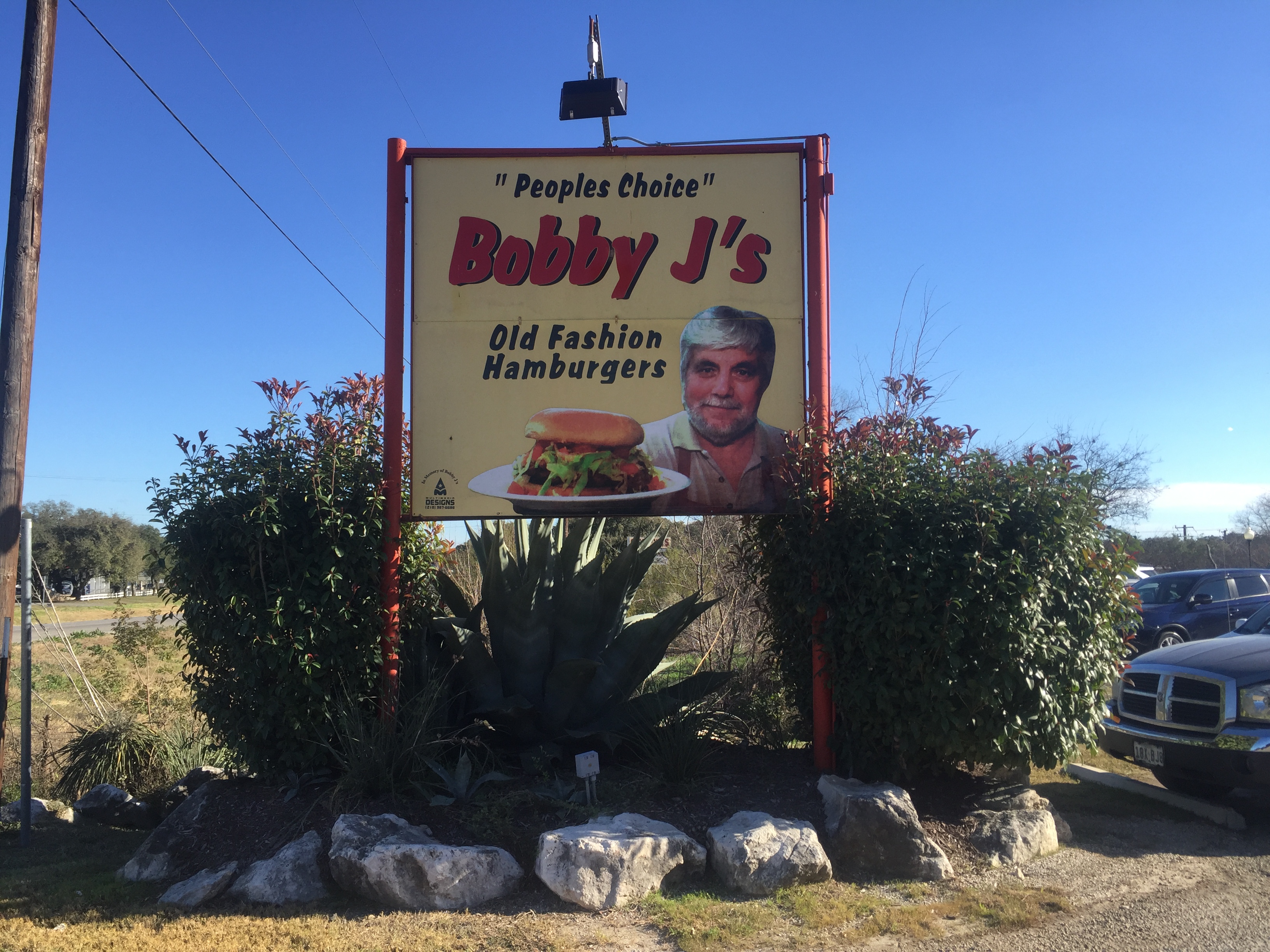
Bobby J's SignFolks have been eating at Helotes for quite a long time. The name Helotes is derived from the Spanish word elotes, meaning corn on the cob. Spanish explorers reported the use of corn on the cob by Apaches in the area as early as the 1700’s. By 1873, Helotes became a stagecoach stop on the Bandera Road, a place where travelers could relax and enjoy a meal.

Bobby J’s was certainly not around in those years when stage coaches traveled the Bandera Road. If it had it would have made Helotes an even more popular stop along this old stage route. Bobby J’s was the brainchild of a real estate guy named Bob Sfalos. In 2000, Sfalos fulfilled a personal dream of opening a burger joint on property that he owned. His wife thought he was crazy but joined him in this new venture to concoct a better-tasting burger.
Bobby J's InteriorAfter eating at every burger place in the area, Sfalos and his wife narrowed their favorites down to three. Then they strategized on how to improve on their favorite burgers and came up with their own secret burger formula. The rest is history. Whatever they came up with worked and soon Bobby J’s earned its own place on top of the burger joint heap. Bobby J’s is undeniably one of the most popular place to eat a burger in the greater San Antonio area.

My buddy and I arrived at Bobby J’s after the lunch crowd — or so we thought. The place had a steady stream of customers the entire time we were there. I ordered the Jalapeño Cheddar Cheese Burger with a side order of onion rings and a glass of sweet tea. A lady named Benita took our order and made us feel right at home. I always appreciate friendly folks like Benita who make a dining experience all the better.
Bobby J's BurgerAs for the burger — it arrived with jalapeños cascading out of the bun. Perfect! I cut the burger in half to reveal a perfectly cooked hand-pressed patty smothered in cheese. The first bite confirmed everything I had heard from my friend who recommended I eat at Bobby J’s. That first bite told me that this was destined to be one of my favorite burger dining experiences. And, the onion rings were the perfect companion to this meal.
Bobby J's Burger HalfBobby J’s is definitely a burger joint I will have to visit again. I enjoyed the eclectic license-plate themed decor and absolutely loved the burger. Along with countless others who have eaten at Bobby J’s, I am glad that Bob Sfalos left the real estate business to make burgers. If you find yourself anywhere near San Antonio, set your compass to Helotes and head on over to Bobby J’s for one of the most delicious burgers in the Lone Star State.

Hiking to Gorman Falls

Gorman Falls is one of the Lone Star State’s best tucked away treasures — a hidden gem of a site. Located along a remote section of the Colorado River, the falls are a part of Colorado Bend State Park. Although the falls are located a little more than a mile from the trailhead, getting there requires a semi-strenuous hike along a rugged but scenic trail.
Gorman Falls TrailThe last hundred yards of the trail require cautiously working your way down a steep descent along slick outcroppings of rock. You will hear the sound of the water as you make your final approach. The park service has placed cables along this final section of the trail to give hikers a handhold along the steep descent to the base of the falls.
Omar at Gorman FallsThe final steps of the hike lead down to a heavily shaded bluff at the base of the falls next to the Colorado River. There is a nice seating area there, something akin to a pew in this heavily shaded area that feels like a beautiful outdoor cathedral. This is a relaxing spot to sit and enjoy the sound of the falls under the shade of the trees.
Gorman Falls (Web Pic)Gorman Falls are fed by Gorman Springs. Cascading down from a 60-foot high limestone cliff, the calcium deposits in the water have created what look like window drapes. These formations are covered with green moss and ferns, adding a calming beauty to the picturesque scene. The park service has restricted access to the base of the falls to help protect the area from damage, so don’t expect to take a dip there.
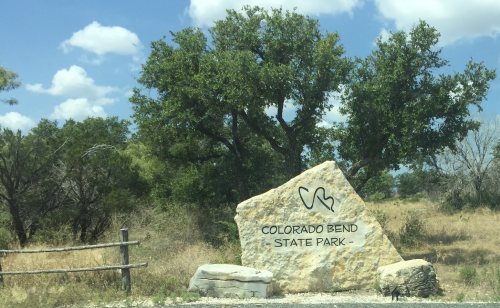
Colorado Bend State ParkAccording to my hiking app, my round-trip hike to Gorman Falls from the trailhead was 3.2 miles. There is little shade along the trail so you might want to wear a ball cap. Although this is not a long hike, don’t make the mistake of hiking in poor shoes or flip-flops or it will definitely feel like a much longer hike. And be sure to take plenty of water to stay hydrated. When you finally arrive at the falls, you’ll agree that hiking to Gorman Falls is definitely worth every step that it takes to get there.