
I come by my curiosity honestly. My grandfather, Felipe Garcia, was a curious man—always learning, always investigating, always wanting to know more about the world around him. And he did all of this long before the internet, when curious people had to work a little harder to find answers to their questions.
Apparently, on October 11, 1974, something blooming in his garden in Mission, Texas, caught his attention.
I know the exact date because he wrote it down.
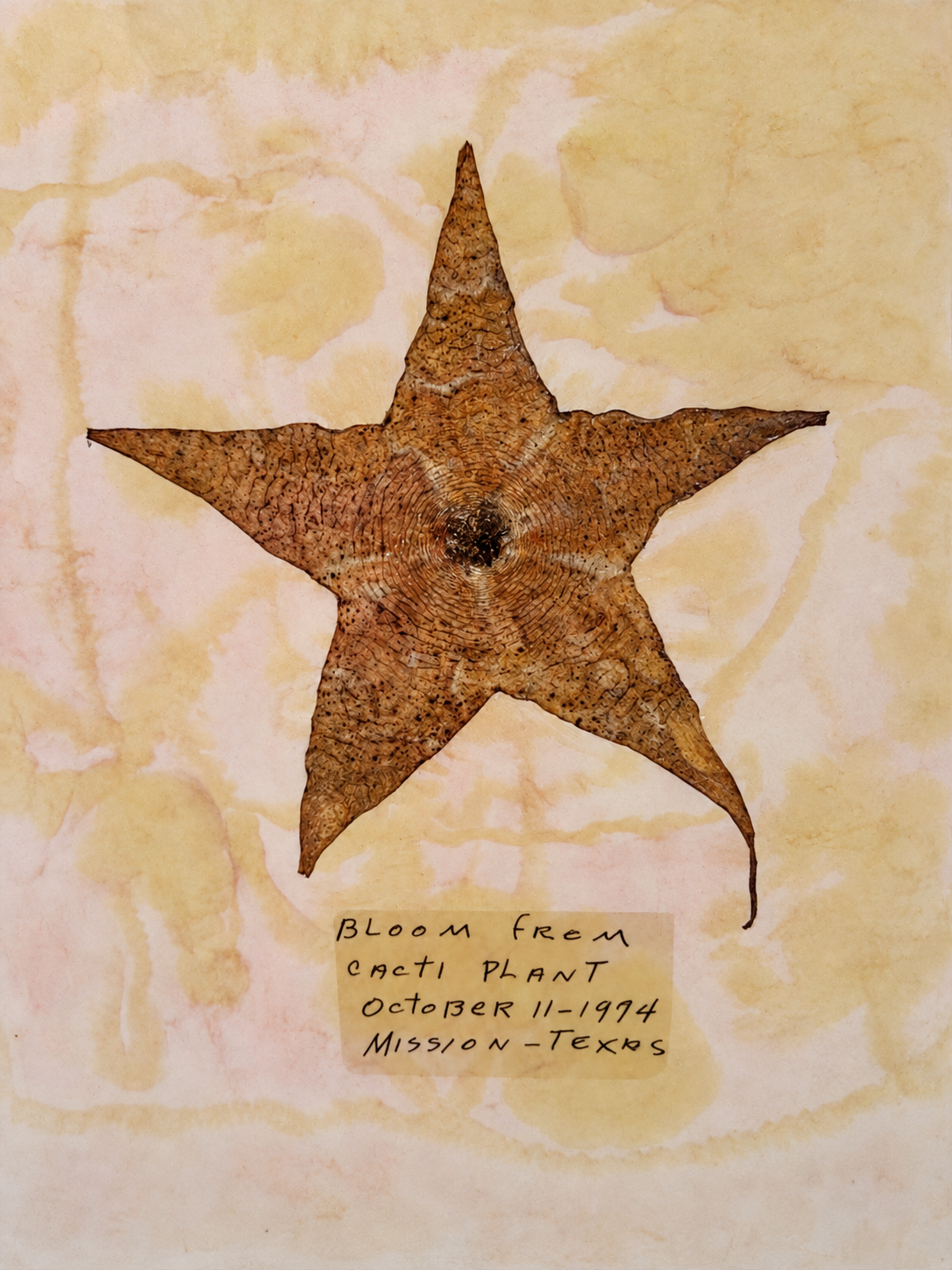
My grandfather was so impressed by the star-shaped blossom that he preserved it beneath a protective covering. Beneath it, in his handwriting, are these simple words:
Bloom from cacti plant
October 11, 1974
Mission Texas
More than fifty years later, the blossom is still beautiful. It measures almost seven inches from top to bottom and from side to side. Whatever color it once was has faded with time, but its unusual shape and intricate markings remain visible.
I had no idea what it was.
So, like my grandfather, I got curious and started digging.
My digital search took me down numerous horticultural paths as I tried to identify the plant that had produced such an unusual blossom. I even looked into what cactus nurseries in the Rio Grande Valley were growing and selling in the decades before my grandfather preserved his flower.
Eventually, my search led me to a plant called Stapelia gigantea.
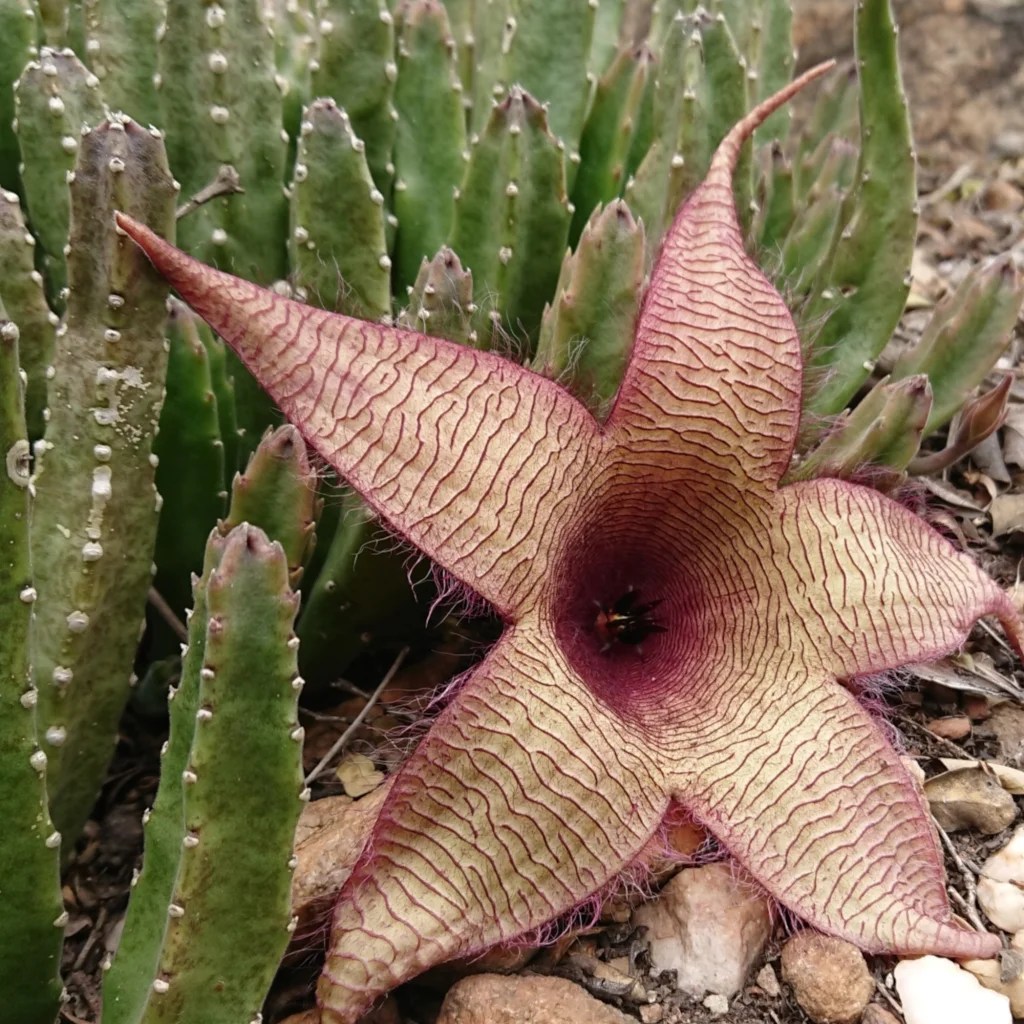
I learned that it isn’t actually a cactus, although it is commonly mistaken for one. Stapelia gigantea is an African succulent known for producing enormous, star-shaped flowers. People commonly call it the giant carrion flower, giant starfish flower, or Giant Star of Bethlehem. Ironically, it is also widely called a starfish cactus.
And then my search turned up something particularly interesting.
In 1961–62, an Edinburg cactus business called Aunt Pat published a commercial catalog that offered Stapelia gigantea under the peculiar name “Giant Toad Plant.” The same catalog offered Stapelia variegata as the “Star Fish” plant.
So this tells me that Stapelia gigantea was commercially available in the Rio Grande Valley roughly thirteen years before my grandfather preserved his blossom in Mission.
I will never know whether my grandfather bought his plant from a local nursery or nurtured it from a cutting a friend gave him. However it happened, this unusual African succulent grew in his garden.
And when it bloomed in his garden, he noticed.
He was 83 years old.
Still noticing.
Still wondering.
Still curious.
There is something to be said for remaining curious for a lifetime. The wonderful thing about curiosity is that it keeps us learning. It makes us notice things others walk past and ask questions others never think to ask.
Children are naturally curious. They examine bugs, turn over rocks, look at the stars, and ask an endless stream of questions. But somewhere along the way, many adults lose their appetite for curiosity. We get busy. We settle into routines. We stop noticing. And eventually, we stop asking questions.
My grandfather apparently never did.
And, as I’ve said, I come by my curiosity honestly. More than fifty years after my grandfather became curious about a star-shaped blossom in his garden, his curiosity awakened mine about the very same blossom.
I had to know more.
I had to dig deeper.
I regard curiosity as one of my grandfather’s legacies—a gift he left to his family. His interest in a strange and beautiful blossom has now become my interest. The flower he stopped to examine all those years ago invited me, more than half a century later, to keep looking, learning, investigating, and wondering.
One thing is certain: a curious life is rarely boring. There is always another road to travel, another person to meet, another book to read, another piece of history to uncover, another flower to examine, and another question worth asking.
So stay curious. Notice things. Wonder out loud. Ask questions. Investigate.
Sometimes an entire story is waiting inside something as simple as a blossom.

